
THANK YOU FOR SUBSCRIBING

Pharma Tech Outlook Weekly Brief
Be first to read the latest tech news, Industry Leader's Insights, and CIO interviews of medium and large enterprises exclusively from Pharma Tech Outlook


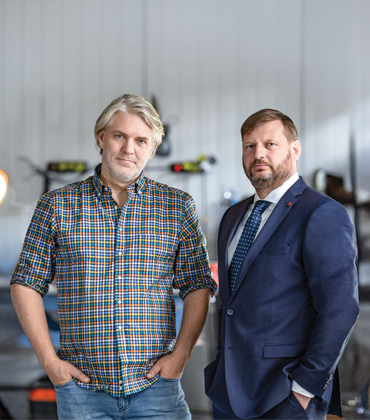 Paweł Mierzejewski, Co-Founder and CEO, Michał Jaworski, Co-Founder and COO
That’s because most customisations rely on a predefined architecture. While suppliers may offer configurable options, the starting point remains a fixed platform, designed for flexibility rather than reinvention. This can quickly become a bottleneck, particularly for companies navigating scientific breakthroughs. When process requirements evolve, the equipment must evolve with them.
That’s where Persep finds its edge.
Based in Poland, Persep is part of a next-generation equipment manufacturer that doesn’t begin with a catalogue of equipment. Instead, each system is made to order, engineered from the ground up to match the exact needs of the client’s process. Whether a sterile fill-finish line is being developed for a first-in-human trial or a scalable bioprocess system for a personalised therapy, Persep treats every project as a unique challenge rather than a product adaptation.
“Our starting point isn’t a brochure. It’s the process flow diagram,” says Paweł Mierzejewski, co-founder and CEO. “If a client’s formulation team has created something unique, our job is to engineer the equipment that can bring that idea into full-scale production.”
This is engineering with intent. Every dimension, integration point and process parameter is considered in the context of the client’s facility, product profile, and production cadence. Its systems support the full lifecycle of pharmaceutical innovation from the earliest lab-scale validation to full-scale GMP manufacturing.
This approach brings a level of customisation rarely seen in traditional builds. Engaging directly with process engineers, QA teams and production planners ensures development is aligned with the client’s operational realities. The company’s lean, collaborative structure allows for real-time adjustments to user requirement specifications (URS) as projects evolve, without disrupting timelines or regulatory pathways.
Every component Persep delivers is traceable, every system is qualification ready, and every proposal is grounded in the needs of the manufacturing process
At a time when pharmaceutical manufacturing is under pressure to be faster, more adaptive, and more transparent, Persep isn’t just meeting the moment. It’s helping to define what the next generation of pharma equipment design should look like.
A Custom Team for Every Custom Machine
Persep’s team structure doesn’t follow the standard playbook of pharmaceutical equipment suppliers either. Instead of relying on large internal divisions and fixed-role departments, IT assembles agile, project-specific teams suited to the unique technical demands of each engagement. They are domain experts selected for their depth of experience in the exact process the client is working to scale or refine.
Many of these specialists are former senior engineers from top pharmaceutical manufacturers or academic leaders from Poland’s premier institutions. Their knowledge spans mechanical design and the operational realities of GMP environments, crucial factors when engineering systems that must transition seamlessly from concept to compliance.
What differentiates Persep is both who it brings into a project, and when. The team is involved early, working side by side with the people drafting RFQs and defining URS documents. Often, the engineers, plant managers and technical leads are closest to the process. This early integration allows Persep to help optimise process and instrumentation diagrams (P&ID), consolidate functions across equipment, and even prevent unnecessary purchases.
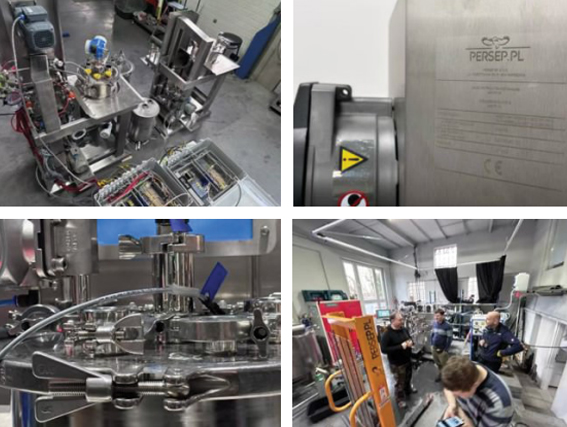 In one notable project, the team’s involvement helped a client avoid investing in a standalone, clean-in-place unit. It modified an existing vessel with a higher-powered pump, achieving both cost savings and footprint efficiency without compromising on validation.
Even leadership engagement is more than symbolic at Persep. Mierzejewski oversees every stage of development from initial prototyping to mechanical design to final production. He also shapes the company’s distinct design language, which blends technical rigour with clean, operator-focused usability. Co-founder and COO Michał Jaworski leads client relationships, from the first conversation to final delivery, ensuring every project is grounded in a clear understanding of process needs. It’s this aesthetic and functional signature, combined with close client collaboration, that has made Persep’s systems instantly recognisable within pharma and biotech facilities across Europe.
With each project, the team reinforces Persep’s identity as a company that does more than build equipment. It builds around the process, people and the production goals of clients. That ability to deliver both precision and partnership makes Persep one of the most distinctive and forward-thinking equipment engineering firms in the European life sciences sector.
In most pharmaceutical equipment companies, the blueprint is treated as gospel. Once the computer-aided design file is approved, production moves ahead under the assumption that what works on screen will work in practice. But Persep approaches the design phase differently—not as a finish line, but as a starting point.
Every system undergoes rigorous real-world testing before it’s considered complete. It deliberately builds beyond the assumptions of the file, pushing systems under operating conditions to see how they perform when theory meets reality. If something doesn’t hold up, it’s reworked. If software lags behind mechanical function, it’s resynchronised. And when a better solution surfaces midstream, the team doesn’t hesitate to redesign from scratch.
“Making the parts and assembling them is the easy part,” says Jaworski. “What really counts is testing, improving and doing it again until the result isn’t just functional, it’s flawless.
Persep took a different approach. Instead of refining the old method, it reimagined it altogether. The team developed a custom hydraulic calibration system that simulated weight through controlled water pressure, eliminating the need for physical loads. As a result, the client was able to calibrate 30 vessels in a single week, using only in-house staff and without lifting a single kilogram of steel.
The improvement was deeply felt.
“Operators, not just managers, came up to us and said, ‘Thank you. This makes our job easier,” recalls Jaworski. “That kind of feedback matters. Because when the people who use the equipment every day feel the difference, you know you’ve done something right.”
Where Standard Still Means Custom
Even the most repeatable products in Persep’s portfolio are never off-the-shelf in the traditional sense. They’re standardised where it makes sense, but always built with intent, and always grounded in the needs of the process.
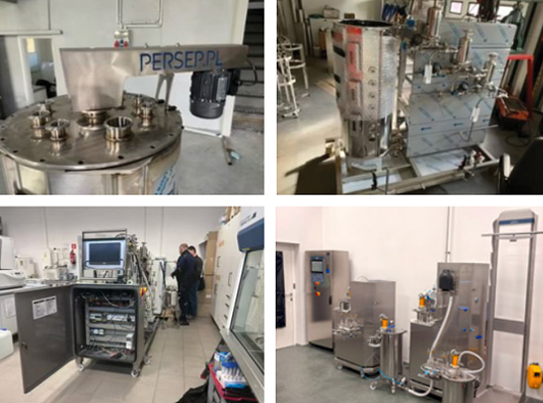
Take its pharmaceutical-grade vessels. These units form the backbone of many client operations, supporting everything from buffer preparation to product storage and management. Some are configured as mobile tanks for fluid transfer, others are integrated directly into filtration skids or automated production lines. While the base structure remains consistent, every functional element, from inlet positioning and valve selection to impeller geometry and vessel dimensions, is tailored to meet the facility’s specific requirements and process logic.
The same philosophy shapes its tangential flow filtration systems. Though each unit follows a proven architectural framework, it’s calibrated for the client’s unique flow paths, filtration cycles and instrumentation preferences. This blend of trusted design with deep customisation also defines Persep’s modular skids and bioreactors.
“We’re able to move quickly because we design with discipline,” says Mierzejewski. “But we never assume that what worked for one project will automatically fit the next.”
Even Persep’s clean room furnishings—tables, chairs, racks and suspension frames—are treated with the same care. They may appear simple, but each item is engineered for function inside controlled environments, allowing operators in full protective gear to work with efficiency and comfort. When tasks require long hours of fine motor control, ergonomics is essential.
These design choices are not made in isolation. Persep’s engineers routinely observe workflows inside clean rooms, identifying friction points and translating real-world feedback into refinements that improve everyday use. In this industry, performance isn’t defined only by major capital equipment. It’s just as often shaped by the tools and structures that support human precision.
Becoming the Backbone of Pharma Manufacturing in Poland
When Persep first entered the pharmaceutical equipment market five years ago, few expected it to endure, let alone thrive. The industry tends to favour size, legacy and familiarity. Small, agile teams without a multinational name behind them are hardly seen as safe bets. A company built on adaptability, rather than hierarchy, sounded promising in principle, but the question was whether clients would entrust critical infrastructure to such a model.
Persep didn’t just prove them wrong; it earned their confidence.
 It is now a trusted partner to some of Poland’s most prominent pharmaceutical manufacturers. Its success hasn’t come from being the largest supplier, but from being the most responsive, most consistent and most aligned with the realities of pharmaceutical production. That trust was built one project at a time, through systems that meet the full rigour of GMP and validation requirements without the excess complexity or rigidity that comes with many players.
Every component Persep delivers is traceable, every system is qualification ready, and every proposal is grounded in the needs of the manufacturing process. In a field where credibility is hard-won, Persep has established itself by delivering exactly what it promises.
From Biotech Beginnings to Pharma Trust
Persep’s story started in biotech. In its earliest years, it engineered complete bioreactor lines and built specialised systems for emerging biotech firms. These projects required technical depth but often operated outside the structured framework of formal validation protocols, such as installation and operational qualification. These formative engagements offered more than just engineering complexity; they provided the team with direct exposure to fast-moving process environments, where success hinged on rapid iteration, practical innovation and a deep understanding of processes.
That foundation became the hallmark of Persep’s approach in the pharma world.
As it expanded into pharmaceutical manufacturing, it brought with it the same design agility, now adapted to meet the documentation rigour, qualification pathways and compliance requirements essential in regulated pharma settings. The result is its successful blend of bespoke engineering and validation-ready precision, allowing Persep to deliver made-to-order systems that meet both process needs and inspection standards with equal measure.
Even as it champions speed and flexibility, Persep never cuts corners. Every system is built with pharmaceutical-grade materials. The team partners with vetted local suppliers, verifies every specification and documents every step of the build process, ensuring transparency from design to audit. This disciplined, purpose-driven approach is helping it reshape how specialty pharmaceutical equipment is built across Central and Eastern Europe.
Persep may not yet have the name recognition of a global OEM, but what it has earned project by project, client by client, is far more enduring—the trust of clients who keep coming back.
Email Id: biuro@persep.pl
Phone Number: +48 669 436 967
Company
Persep
Management
Paweł Mierzejewski, Co-Founder and CEO, Michał Jaworski, Co-Founder and COO
Description
Persep is part of a next-generation equipment manufacturer that doesn’t begin with a catalogue of equipment. Instead, each system is made to order, engineered from the ground up to match the exact needs of the client’s process. Every dimension, integration point and process parameter is considered in the context of the client’s facility, product profile, and production cadence.